High-Lumen vs Standard Flashlights: A Cost-Performance Guide for Wholesale Buyers

You want the best flashlight for your budget. High-lumen options like Shenzhen Qunlang’s Flashlight deliver premium brightness but often cost more. Standard models, such as Guangdong Dingneng’s Focus Torch at $1.20 per piece, offer strong value. Use this buying guide to compare cost-performance and learn how to choose the best flashlight or flashlight supplier.
Model | Lumens | Price per Piece | Durability Rating | Manufacturer Rating |
|---|---|---|---|---|
Ningbo Meeko’s Spotlight | 10,000+ | N/A | N/A | 4.9 |
Shenzhen Qunlang’s Flashlight | 5000 | Premium | IP68 | N/A |
Guangdong Dingneng’s Focus Torch | N/A | $1.20 | N/A | N/A |
Ningbo Topcom’s P90 | 2000 | $7.99+ | IP55 | 4.5 |
Key Takeaways
High-lumen flashlights provide maximum brightness and durability, making them ideal for professional use in demanding environments.
Standard flashlights are cost-effective for everyday tasks, offering reliable performance without the need for high brightness.
When purchasing in bulk, consider tiered pricing models to maximize savings and negotiate better deals with suppliers.
Flashlight Types and Lumens
High-Lumen Flashlight Features
You need powerful led flashlights when your work demands maximum brightness. High-lumen models use advanced led flashlight technology to deliver intense beams. These units often exceed 1000 lumens, making them ideal for tactical, industrial, or search and rescue operations. High-powered led units feature robust construction, waterproof ratings, and extended battery life. You will notice that powerful led flashlights provide superior visibility in challenging environments. Many wholesale buyers choose these flashlights for professional use because they offer reliability and performance.
Standard Flashlight Characteristics
Standard led flashlights serve everyday needs. You can rely on these models for household tasks, basic outdoor activities, or emergency kits. Most standard flashlights produce between 50 and 300 lumens. They use efficient led bulbs and simple designs to keep costs low. You will find that standard led flashlights are lightweight, easy to carry, and affordable for bulk purchases. These flashlights suit retail markets and general consumer use, where powerful beams are not necessary.
Tip: Match the lumen rating to your application for the best value.
Lumen Range | Application Description |
|---|---|
50 to 300 lumens | Suitable for everyday household use such as reading, finding items, or emergency power outages. |
300 to 1000 lumens | Ideal for camping, hiking, night running, and other outdoor activities. |
Above 1000 lumens | Tactical or professional-grade flashlights used for law enforcement and search and rescue. |
Lumens vs Watts Explained
You should focus on lumens when comparing led flashlights. Lumens measure the total light output, while watts indicate energy consumption. A powerful led flashlight with high lumens will appear brighter, even if it uses fewer watts. Modern led technology allows you to get more lumens per watt, improving efficiency and reducing costs. Always check the lumen rating to ensure you select the right flashlight for your needs.
Cost Factors for Wholesale Buyers
Upfront and Bulk Pricing
When you compare the initial cost of a flashlight, you notice that high-lumen models usually have a higher price than standard options. The price difference reflects advanced technology, stronger materials, and higher quality. Wholesale buyers often benefit from bulk discounts, which can make even premium flashlights more affordable. Suppliers use different pricing models to attract large orders. You should understand these models to maximize your savings.
Pricing Model | Description |
|---|---|
Tiered Pricing | Discounts increase as order quantity rises, ideal for bulk purchases. |
Fixed Pricing | Price remains constant regardless of order size, suitable for smaller orders. |
Dynamic Pricing | Prices vary based on market demand, offering potential savings during off-peak times. |
You can negotiate better led flashlight prices when you order in large quantities. Tiered pricing gives you the best value if you plan to buy hundreds or thousands of units. Dynamic pricing lets you take advantage of market fluctuations, especially if you monitor demand trends. Fixed pricing works for smaller orders but may not offer the same savings.
Tip: Always request a detailed quote from your supplier. This helps you compare led flashlight prices and spot hidden fees.
Battery and Maintenance Costs
Battery choice plays a major role in the total cost of owning a flashlight. High-lumen flashlights often require more powerful batteries, which can increase your expenses over time. Standard flashlights use less energy, so you spend less on batteries and maintenance. You should also consider warranty and after-sales support when calculating long-term costs.
A longer warranty period gives you peace of mind and protects your investment. It shows the supplier’s commitment to quality.
Reliable after-sales support ensures you get quick help if your flashlight fails. This keeps your operations running smoothly.
Routine maintenance, such as cleaning contacts and replacing batteries, affects your overall cost. High-lumen models may need more frequent battery changes, especially in demanding environments. Standard flashlights require less upkeep, making them a better choice for low-intensity use.
Rechargeable vs Disposable Batteries
Your choice between rechargeable and disposable batteries has a big impact on cost and environmental responsibility. Rechargeable batteries cost more upfront but save you money in the long run. Disposable batteries seem cheaper at first, but replacement costs add up quickly.
Factor | Disposable Alkaline Batteries | Rechargeable NiMH Batteries |
|---|---|---|
Initial Cost (4 AA) | $4.00 – $6.00 | $25.00 – $40.00 (with charger) |
Lifespan per Unit | Single use (~5–20 hrs) | 500–1000 charge cycles |
Annual Replacement (4 used/month) | 48 batteries/year | None (same set reused) |
5-Year Battery Cost | $240.00 (at $1 each) | $30.00 (one-time) |
Electricity Cost (charging) | $0.00 | $4.00 (estimated) |
Total 5-Year Cost | $240.00 | $34.00 |
Savings with Rechargeables | — | $206.00 |
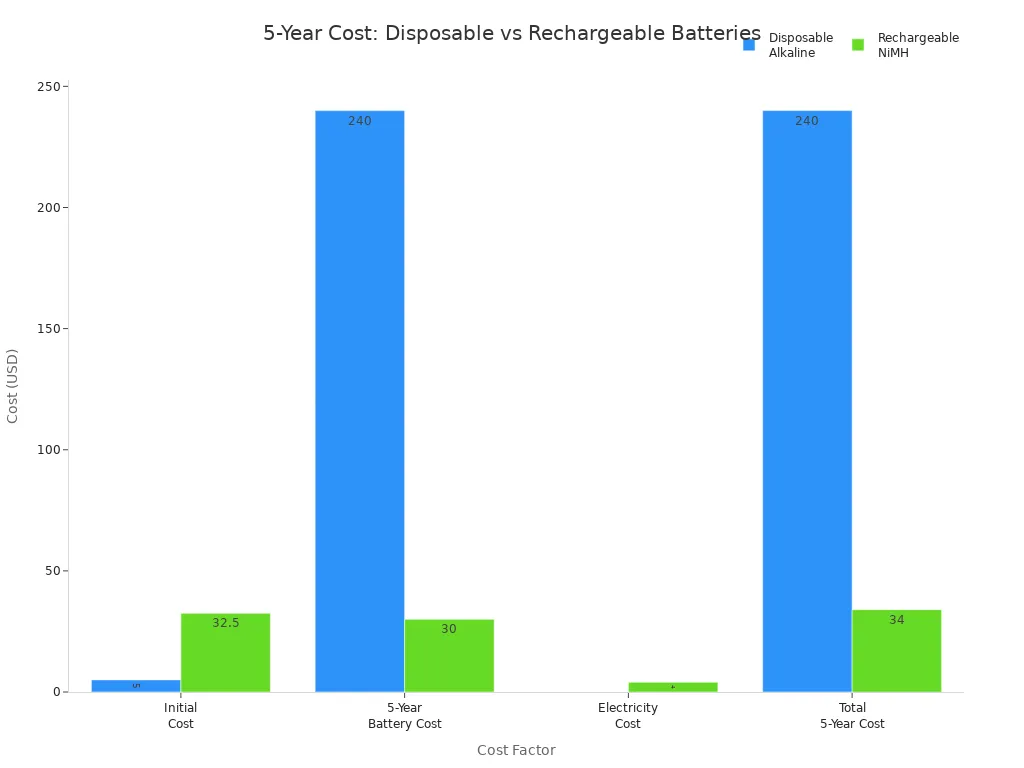
You reduce waste and save money when you choose rechargeable batteries for high-use applications. A single rechargeable battery can replace up to 1000 disposable batteries over its lifetime. This leads to significant savings and less environmental impact. For low-use scenarios, disposable batteries may be more practical, but you should recycle them properly to minimize harm.
Rechargeable batteries work best in high-use situations, cutting down on material consumption and waste.
The environmental cost per use is lower for rechargeables, even though manufacturing them has a higher initial impact.
Proper recycling is important for both types, especially since rechargeable batteries contain hazardous materials.
Note: If you want to maximize savings and reduce your environmental footprint, choose rechargeable batteries for your flashlight orders.
Flashlight Performance and Brightness
Brightness and Runtime
You need to evaluate both brightness and runtime when selecting a flashlight for wholesale purchase. Brightness, measured in lumens, determines how much light the flashlight emits. Runtime, measured in hours, tells you how long the flashlight will operate before the battery runs out. High-lumen flashlights deliver intense brightness, but they consume more power, which shortens battery life. Standard flashlights offer moderate brightness and typically last longer on a single charge or set of batteries.
Brightness (Lumens) | Battery Life (Hours) | Relationship |
|---|---|---|
High | Short | Inverse |
Standard | Longer | Inverse |
You should find a balance between led flashlight brightness and runtime based on your needs. If you require extended use, such as during overnight shifts or long outdoor activities, a standard flashlight may serve you better. High-lumen models suit situations where maximum visibility is critical, even if you need to recharge or replace batteries more often.
Brightness is measured in lumens.
Runtime is measured in hours.
Higher brightness typically requires more power, leading to shorter battery life.
Note: For extended use or limited access to power, choose a flashlight with lower lumens and longer battery life.
Durability and Build Quality
You want a flashlight that withstands tough conditions. High-lumen flashlights often feature robust construction, using materials like aluminum alloy for enhanced durability. These models include advanced thermal regulation to manage heat from powerful LEDs. Standard flashlights may use lighter materials, which can vary in quality. Both types should comply with ANSI FL1 standards to ensure reliable performance.
High-lumen flashlights often use aluminum alloy for durability.
Thermal regulation is essential in high-lumen models to prevent overheating.
Standard flashlights may use plastic or mixed materials, which affects durability.
Waterproof ratings, such as IP55 or IP68, indicate resistance to water and dust. Waterproof flashlights are ideal for outdoor or industrial environments.
You should prioritize models with reliable battery systems, such as 18650 or Li-ion packs, for high-lumen flashlights. Adjustable beam focus adds versatility, especially for professional applications. Standard flashlights may not require these features, but you should still check for basic waterproof protection and sturdy build quality.
Tip: Always check the waterproof rating and material specifications before placing a bulk order.
Application Suitability
You need to match flashlight performance to your intended application. High-lumen flashlights excel in tactical, industrial, and emergency scenarios where maximum brightness and rugged durability are essential. These models provide superior visibility in search and rescue, law enforcement, and construction settings. Standard flashlights work well for everyday use, retail sales, and basic outdoor activities.
Aspect | Impact on Flashlights |
|---|---|
Energy Efficiency | Higher lumen-per-watt efficiency improves performance. |
Lifespan | Longer lifespan increases practicality for users. |
Brightness | Enhanced brightness narrows the gap between types. |
Technological advancements in LED efficiency have improved both high-lumen and standard flashlights. You benefit from longer lifespans and better energy efficiency, which increases overall performance. Enhanced brightness in standard models now meets many consumer needs, narrowing the gap between flashlight types.
High-lumen flashlights suit demanding environments and professional use.
Standard flashlights are ideal for general consumer markets and low-intensity tasks.
Waterproof flashlights offer added protection for outdoor and industrial applications.
Callout: Choose the flashlight type that aligns with your operational requirements. Consider brightness, durability, and waterproof features to maximize value and performance.
Best Flashlight Choices by Scenario
Industrial and Commercial Use
You need the best flashlight for demanding environments. Industrial buyers often weigh brightness against cost. High-lumen models from the best flashlight brands offer superior performance, but you must consider your budget. The table below shows how price and features influence your decision:
Price Range | Features | Buyer Priority |
|---|---|---|
$120 - $350 | Genuine 100,000-lumen, reliable components | High performance vs. cost |
<$100 | Inflated lumen ratings, lower quality | Lower cost, potential risk |
$150 - $250 | Balance of performance and reliability from top brands | Optimal choice for many buyers |
$250+ | Advanced thermal design, extended warranties | Willingness to invest for quality |
You should select tactical flashlights with high lumens for construction, warehouse, or night operations. These models deliver the best flashlight performance for safety and productivity. For camping or outdoor work, camping flashlights with rugged builds and long runtime provide excellent value.
Retail and Consumer Markets
Retail buyers look for the best flashlight that balances price, durability, and features. You want products that appeal to a wide range of customers, from those needing camping flashlights to those seeking emergency flashlights for home use. Key features include:
Brightness levels for different tasks
Durable, impact-resistant builds
Water resistance for camping and outdoor use
Rechargeable and disposable battery options
Compact size for portability
Extra modes for tactical flashlights
You can boost sales by stocking the best flashlight brands that offer reliable camping flashlights and emergency flashlights. Customers value versatility, so choose models that work for camping, hiking, and emergency situations.
Emergency and Safety Needs
You must prioritize safety when selecting the best flashlight for emergency use. Emergency flashlights need to perform reliably in critical situations. For high-risk areas, intrinsically safe models provide lightweight, safe lighting. Explosion proof flashlights offer durability and long runtime for less volatile environments. Emergency flashlights with waterproof and shockproof features are essential for disaster kits, camping, and rescue operations.
Tip: Always keep emergency flashlights in your inventory for camping, power outages, and safety kits. The best flashlight for emergency use combines high brightness, long battery life, and rugged construction.
You can meet diverse needs by choosing the best flashlight for each scenario. Focus on quality, reliability, and suitability for camping, emergency, and tactical applications.
Flashlight Supplier Checklist
Assessing Supplier Reliability
You need to evaluate each flashlight supplier before placing a bulk order. Reliable suppliers hold certifications and maintain strong production capabilities. You should check for CE, UL, or RoHS labels and request documentation to confirm authenticity. Collaborate with suppliers who work with accredited testing facilities. This ensures flashlights meet international safety and performance standards. Use the following criteria to guide your assessment:
Criteria | Description |
|---|---|
Certifications | Suppliers must follow strict industry standards to reduce defective products. |
Production Capabilities | Evaluate the ability to meet demand and maintain quality. |
Product Quality | Confirm each flashlight passes functional and safety tests. |
After-Sales Support | Reliable support after purchase increases your confidence. |
Tip: Always invest time in due diligence. A trustworthy flashlight supplier protects your business from supply chain risks.
Matching Flashlight to Buyer Needs
You should match the flashlight type to your specific requirements. If you need high-output lighting, choose a flashlight supplier specializing in models above 10,000 lumens. Look for premium LEDs, advanced thermal management, and multi-mode functionality. For general use, select suppliers offering durable, efficient standard flashlights. Verify waterproof ratings and charging options to ensure suitability for your market.
Ensure the supplier provides technical documentation and test reports.
Request performance tests for brightness, runtime, and durability.
Evaluating Cost-Performance
You must compare cost and features across multiple suppliers. Entry-level flashlights cost less but may lack durability. Mid-range options offer reliable brands and solid construction. Premium models deliver advanced optics and smart interfaces for demanding users. Use the table below to guide your decision:
Price Tier | Features |
|---|---|
Budget ($20–$50) | Moderate output, basic durability, suitable for occasional use. |
Mid-Range ($50–$120) | Reliable brands, 1000+ lumens, multiple modes, solid build. |
Premium ($120–$250) | Tactical-grade, advanced optics, smart features, exceptional longevity. |
Note: Choose a flashlight supplier who balances price with performance. This ensures you get the best value for your investment.
You see clear cost and performance differences between high-lumen and standard flashlights. Wholesale buyers often find the best value in mid-range models, which balance price and reliability:
Price Range | Description |
|---|---|
Mid-Range ($50–$120) | Reliable brands, good build, rechargeable batteries, realistic performance claims. |
Wholesale pricing offers strong profit margins.
Assess your needs and negotiate bulk discounts.
Match features to your specific scenarios for the best results.
FAQ
What is the most cost-effective flashlight type for bulk orders?
You get the best value from mid-range standard LED flashlights. These models balance price, reliability, and performance for most wholesale applications.
How do you choose a reliable flashlight supplier?
Criteria | Why It Matters |
|---|---|
Certifications | Ensures product safety |
Support | Reduces downtime |
Quality Tests | Confirms durability |
Should you select rechargeable or disposable batteries for wholesale flashlights?
Rechargeable batteries save money over time.
Disposable batteries work best for low-use scenarios.
You should consider environmental impact and usage frequency.
See Also
Understanding Flashlight Lumens: Your Ultimate Brightness Resource
Selecting The Perfect Flashlight For Your Home Needs
Tips For Selecting The Ideal High Power Flashlight
A New Hunter's Guide To Selecting The Best Flashlight
Comparing Diving Flashlights With Standard Flashlights: Key Differences