“How LED Wattage Affects Wholesale Pricing and Profit Margins for Importers”


When evaluating wholesale pricing and profit margins for helius flashlight products, you must consider LED wattage. Manufacturing costs increase with higher wattage, which impacts your bottom line. Battery capacity determines how powerful your reliable helius flashlights can be, and different regions may prefer specific output levels. If you operate as a wholesale flashlight distributor, understanding wattage choices is essential for optimizing your supply chain and business strategy in the flashlight wholesale market.
Tip: Analyzing wattage and battery capacity allows you to select helius flashlight products that meet market demand and boost profitability for your flashlight wholesale business.
Key Takeaways
LED wattage directly affects manufacturing costs. Higher wattage increases complexity and price per unit, impacting your profit margins.
Battery capacity limits the wattage you can offer. Balance performance and cost to meet customer expectations while maintaining profitability.
Understanding regional market preferences helps tailor your product selection. Adjust pricing strategies based on local demand for specific features.
Negotiate with suppliers to manage costs effectively. Strong relationships can lead to better pricing and improved profit margins.
Conduct thorough cost analyses and streamline logistics. These steps enhance supply chain efficiency and maximize your profitability.
LED Wattage and Flashlight Wholesale Pricing
Manufacturing Costs and LED Output
You face direct impacts on manufacturing costs when you select different LED wattage levels for your helius flashlight lineup. Higher wattage LEDs require advanced components and more robust heat management. This increases the complexity of assembly and raises the price per unit. You must also consider technological advancements. Newer LED technology can improve cost-effectiveness by delivering more lumens per watt, which means you get brighter flashlights without a proportional increase in energy consumption or heat output.
Note: Energy-efficient LED systems not only lower energy costs but also extend the lifespan of your helius flashlight products. This reduces replacement frequency and boosts the cost-effectiveness of your inventory.
Manufacturers often pass these savings to you, the wholesale flashlight distributor, allowing you to offer competitive pricing. However, operating within thin margins remains a challenge, especially when economic conditions fluctuate. You must monitor supply chain efficiency to maintain profitability in the flashlight wholesale market.
Battery Capacity and Pricing Strategy
Battery capacity sets a practical limit on how much wattage you can offer in a helius flashlight. High-wattage LEDs demand batteries with greater storage, which increases both the weight and the cost of each unit. You need to balance performance with cost-effectiveness to meet your customers’ expectations.
Here is a breakdown of how battery features influence design and pricing:
Feature | Details |
|---|---|
Battery Type | Lead-Acid |
Light Source | LED |
Lifespan (Hours) | 30000 |
Lamp Luminous Efficiency | 80 lm/w |
Charge time | 12 Hours |
Product Weight (kg) | 0.4 |
Application | LED Lighting Products |
Long Battery Life | Equipped with a high-capacity battery, it delivers extended usage, ideal for prolonged tasks or emergencies. |
You must consider that high-capacity batteries add to the overall cost and affect the cost-effectiveness of your flashlight wholesale offerings. If you choose high-wattage models, you may need to adjust your pricing strategy to reflect the increased value and performance. This ensures your products remain attractive to both end-users and resellers.
Price Ranges for Wholesale Flashlight Distributor
You will notice clear price differences among low, medium, and high wattage models in the flashlight wholesale market. Lower wattage helius flashlight models offer greater cost-effectiveness for bulk orders, while high-wattage units command premium prices due to advanced features and higher battery requirements.
Below is a table showing typical wholesale prices for various LED flashlights:
Product Description | Price |
|---|---|
3 Watt Cree Flashlight 120 Lumens | $24.99 |
LED Bike Light 3 watt CREE XR-E Bulb Aluminum | $29.99 |
28 LED Work Light POP Display of 12 Green | $59.88 |
Cyclops - Illuminated Magnifying Glass With COB LED Light - 12 PC Display | $119.40 |
8-in-1 Pocket Tool Box with LED Flashlight and Task Light 12 PC Display | $131.40 |
Micron Keyring Flashlight With COB LED Light - 24 PC Display | $94.80 |
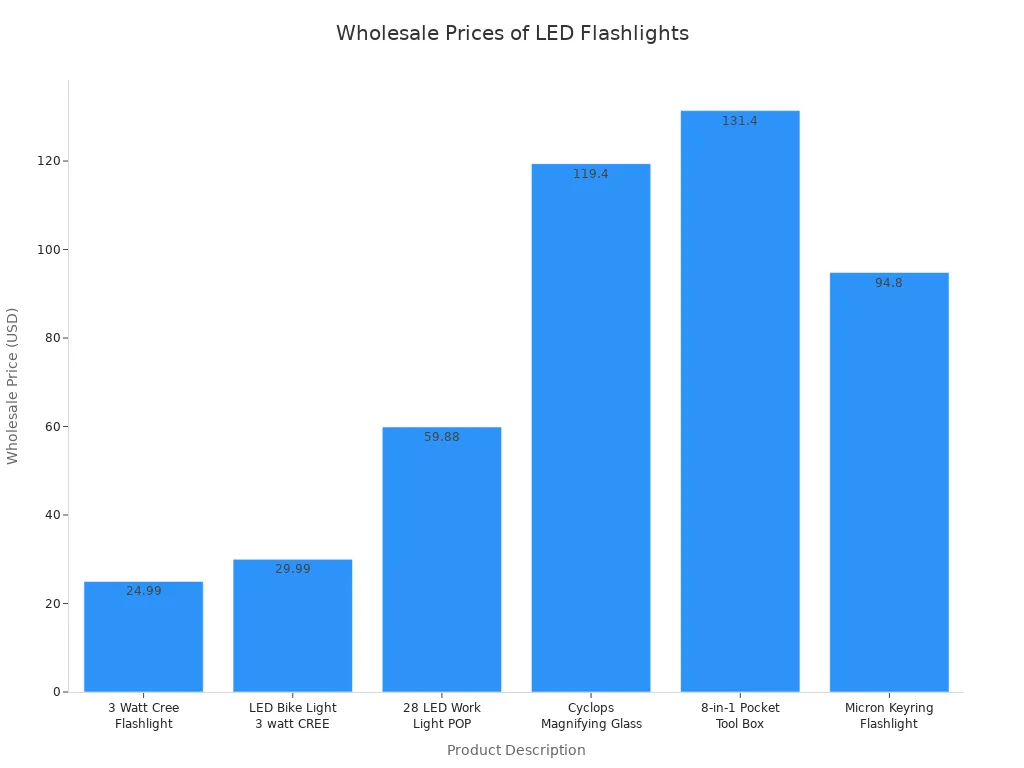
You must also understand how global markets influence pricing for a wholesale flashlight distributor. Suppliers in China, for example, offer lower per-unit costs for higher minimum order quantities. Large manufacturers in regions like Shenzhen focus on advanced electronics, while Zhejiang factories provide better cost-effectiveness for large orders due to lower operational costs. Smaller suppliers may offer more flexibility but at a higher price point.
Other factors that influence wholesale pricing for helius flashlight products include:
Technological advancements in LED and battery efficiency
Battery chemistry, such as the shift to Lithium-Ion cells
Market saturation and competition
Adherence to industry standards
You should always evaluate these elements when sourcing for your flashlight wholesale business. By focusing on cost-effectiveness, you can maximize your profit margins and maintain a competitive edge in the market.
Profit Margins in the Flashlight Supply Chain

Retail Pricing and LED Value
You must understand how LED wattage shapes retail pricing and perceived value in the flashlight supply chain. Customers often associate higher wattage with high-quality flashlights, expecting better brightness and longer service life. When you offer flashlights with advanced energy-saving features, you increase their functional value. Consumers evaluate price and quality closely. If you provide high-quality flashlights at reasonable prices, you boost satisfaction and encourage repeat purchases.
Pricing strategies play a critical role in shaping customer behavior. You can use psychological pricing to highlight the financial advantages of premium models. Higher prices for high-wattage flashlights often signal superior quality to buyers. This perception allows you to maintain healthy profit margins while meeting market expectations for performance and reliability.
Margin Calculations for Bulk Purchase
You need to calculate margins carefully when purchasing flashlights in bulk. The flashlight supply chain involves several cost layers, including manufacturing, shipping, and import duties. Tariffs add to landed costs, which directly affect your profit margins. When tariffs increase, you face higher retail prices. This can reduce sales volume and squeeze your profit.
Consider the following margin calculation example for different wattage levels:
Wattage Level | Wholesale Cost | Tariff & Fees | Retail Price | Margin (%) | Financial Advantages |
|---|---|---|---|---|---|
Low (3W) | $25 | $3 | $40 | 30% | Lower risk, steady demand |
Medium (10W) | $40 | $5 | $65 | 31% | Balanced cost and performance |
High (20W) | $60 | $8 | $95 | 28% | Premium pricing, higher perceived value |
You must negotiate with suppliers to manage costs and protect your profit margins. As tariffs rise, you may need to adjust retail prices. This can risk lowering sales volume while you try to maintain margins. You should monitor supply chain challenges, such as compliance with voltage standards and hidden costs from non-compliance. These issues can lead to storage fees, lost sales, and increased production costs.
Tip: You can maximize financial advantages by selecting wattage levels that match your target market’s expectations and by streamlining your supply chain to reduce unnecessary expenses.
Tariffs and Regional Market Preferences
Tariffs present ongoing supply chain challenges for importers. You must account for increased costs from shipping, duties, and taxes. These costs affect all brands and lead to higher retail prices for LED flashlights. When you pass these costs to consumers, you risk reducing sales volume and overall profit. You need to balance price adjustments with maintaining competitive profit margins.
Regional market preferences also influence demand and margins in the flashlight supply chain. Different regions prioritize specific features and wattage levels. The table below summarizes key characteristics and their impact:
Region | Key Characteristics | Impact on Demand and Profit Margins |
|---|---|---|
Europe | Compliance requirements, sustainability focus | Higher demand for energy-efficient, recyclable products |
Asia Pacific | Fast-growing market, technology integration | Increased demand, cost-sensitive options |
North America | High-specification applications | Stable demand for advanced LED technology |
Latin America | Industrial growth, infrastructure modernization | Emerging opportunities for long-life indicators |
Africa | Mining, utility projects, cost constraints | Limited adoption, focus on basic functionality |
You must adapt your product selection and pricing strategy to match regional preferences. For example, Europe values energy efficiency and compliance, which can justify higher prices and support stronger profit margins. Asia Pacific markets seek cost-effective solutions, so you may need to offer lower-wattage models to maintain financial advantages. North America prefers high-quality flashlights with advanced features, allowing you to target premium segments.
Supply chain challenges such as compliance, hidden costs, and manufacturing adjustments for different markets can impact your profit margins. You should address these issues proactively to protect your profit and maintain a resilient flashlight supply chain.
Note: You can improve your financial advantages by understanding regional preferences and optimizing your supply chain for each market.
Choosing the Best Flashlights for Bulk Purchase
Quality, Features, and LED Selection
You need to evaluate several criteria when selecting the best flashlights for bulk purchase. Product quality stands as the foundation. You should confirm that each flashlight meets safety and performance standards, such as the ANSI/PLATO FL 1 Standard. This benchmark ensures accurate claims about high brightness and runtime. Materials like aluminum and copper provide effective thermal management, which supports high brightness and long battery life. Lithium-ion batteries, especially 21700 cells, deliver reliable performance and sustained output.
Quality Standard | Importance |
|---|---|
ANSI/PLATO FL 1 Standard | Unified benchmark for light output measurement, ensuring accurate performance claims. |
Thermal Management | Maintains performance and prevents overheating, indicating quality design. |
Battery Chemistry | Critical for high output; lithium-ion batteries preferred for their discharge rates. |
Aluminum: Lightweight and excellent thermal conductivity.
Copper: Absorbs heat faster, allowing for brighter and longer runtimes.
Plastic: Unsuitable for high-performance applications due to heat insulation.
Understanding lumen ratings helps you tailor products to specific user needs. Customization based on technical details leads to higher customer satisfaction and repeat sales.
Balancing Cost, Demand, and Profit
You must balance cost, demand, and profit when making bulk purchasing decisions. Higher wattage flashlights offer high brightness, but they increase manufacturing costs. You should assess trade-offs by focusing on long-term performance and overall value. Higher wattage can reduce installation and material costs because fewer units are needed, which results in lower unit costs and improved inventory management.
LED wattage and runtime: Choose flashlights that maintain steady lumen output over time.
Thermal management: Select models with aluminum or copper for effective heat dissipation.
Battery chemistry: Prioritize lithium-ion batteries for long battery life and sustained output.
Segmentation helps you identify high-potential areas for bulk purchasing. Targeting profitable market segments supports informed decision-making and sustainable growth.
Strategies for Wholesale Flashlight Distributor
You can maximize profit margins through strategic bulk purchasing and supply chain management. Building strong supplier relationships allows you to negotiate better pricing and payment terms, which leads to lower unit costs. Bulk purchasing reduces cost per unit and optimizes your budget. Ensuring product quality strengthens your brand reputation and encourages repeat purchases. Focusing on energy efficiency lowers operating expenses and supports overall cost savings.
Strategy | Benefit |
|---|---|
Strong supplier relationships | Better pricing and payment terms, supporting higher profit margins. |
Bulk purchasing | Reduces cost per unit, allowing for budget optimization and increased profit margins. |
Ensuring product quality | Strengthens brand reputation and customer loyalty, leading to repeat purchases. |
Focusing on energy efficiency | Lowers operating expenses, contributing to overall cost savings. |
You should choose suppliers with a diverse range of flashlights for different use cases. Compare wholesale prices and look for volume discounts to achieve lower unit costs. Improved inventory management ensures you meet market demand efficiently. By selecting the best flashlights for bulk purchase with high brightness and long battery life, you position your business for sustainable growth and profitability.
Tip: Tailored product offerings based on market trends and technical features can enhance profitability for importers.
You see a direct link between LED wattage, wholesale pricing, and your profit margins. When you select flashlights for bulk purchase, consider manufacturing costs, battery capacity, tariffs, and market preferences. To optimize your margins and supply chain efficiency, take these steps:
Conduct a thorough cost analysis for every product.
Research market pricing to gauge competitive rates.
Evaluate your product’s value proposition.
Streamline logistics and inventory management.
Negotiate volume discounts with suppliers.
Smart decisions on wattage and features help you maximize profitability and stay competitive.
FAQ
What factors influence flashlight brightness in bulk orders?
You determine flashlight brightness by selecting the right LED wattage and lens design. Higher wattage increases brightness, but you must balance this with battery life and cost. Warehouse operations benefit from consistent brightness, which improves safety and efficiency.
How does battery life affect demand and warehouse operations?
You notice that longer battery life increases demand for flashlights in warehouse operations. Reliable battery life reduces downtime and improves productivity. You save on transportation costs by minimizing frequent replacements and enjoy reduced shipping costs when ordering efficient models.
Why do transportation costs impact flashlight prices?
You face high transportation costs when shipping flashlights with heavy batteries or bulky packaging. These costs raise prices for end-users. You can lower transportation costs by choosing compact designs, which also help with logistics and warehouse operations.
How can you optimize logistics for flashlight distribution?
You streamline logistics by organizing warehouse operations and tracking demand trends. Efficient logistics reduce transportation costs and improve delivery speed. You maintain steady supply and avoid high transportation costs by forecasting demand and managing inventory.
What strategies help you manage cost and demand for flashlights?
You analyze demand patterns and adjust orders to match market needs. You negotiate prices with suppliers to control cost. You select flashlights with optimal brightness and battery life, which supports warehouse operations and reduces transportation costs.
See Also
Exploring Stepless Dimming Features in Modern Flashlights
Comparing LEP and LED: Key Differences Explained
Maximizing Brightness Control with Stepless Dimming Lanterns