Choosing Diving Flashlights for Photography, Spearfishing, and Night Diving Markets

You need the right dive light to match your diving goals and environment. The best dive lights improve your safety, boost performance, and reveal the true beauty of marine life. Before you buy, compare features like the Helius Flashlight or any other light to your specific dive needs.
Key Takeaways
Choose a dive light that matches your main activity, whether it's photography, spearfishing, or night diving. This ensures optimal performance and safety.
Always carry at least two dive lights. A backup light is essential for safety in case your primary light fails during a dive.
Regularly maintain your dive light by rinsing it after each use and checking seals and batteries. Proper care extends the life of your equipment.
Why the Right Dive Light Matters
Safety and Performance
Choosing the right dive light is an essential safety tool for every diver. You rely on your primary light to maintain visibility, communicate with your buddy, and navigate underwater environments. In recreational diving, a well-chosen dive light helps you avoid hazards and supports emergency skills practice. The correct light also allows you to signal for help or mark locations during rescue situations.
Tip: Always carry at least two dive lights to ensure you have a backup if your primary light fails.
The risks of using an unsuitable dive light can be serious. Poor design or inadequate components may cause light leakage, short runtimes, or unsteady power. Cheap batteries and badly cooled LEDs often lead to product failure. Non-constant output lights are common in low to mid-range products, which can be problematic in critical underwater environments.
Safety Incident | Description |
|---|---|
Loss of visibility | Increases the risk of adverse incidents, especially in overhead environments like wrecks or caves. |
Insufficient lighting | Can hinder the ability to see important details, leading to potential accidents during tasks. |
Glare | Reduces visibility and can distract divers, increasing the likelihood of accidents. |
Underwater Experience
Your diving experience depends on the quality and features of your dive light. For recreational diving, a wide, bright beam enhances visibility and enjoyment, especially during night dives. A dive light with a tighter beam angle improves communication and helps you focus on specific areas. High-quality dive lights provide reliable performance, making them an essential safety tool for every underwater adventure.
Selecting the right dive light for your environment improves visibility and enjoyment.
Powerful lights designed for low visibility conditions help you see more and stay safe.
Features like brightness, beam angle, and battery life affect your overall diving experience.
The right dive light transforms your underwater experience, making every dive safer and more enjoyable.
Dive Light Selection Criteria
Choosing the right dive light means understanding how each feature matches your main activity. You need to consider the purpose, beam angle, lumens, battery, and color rendering. Each factor plays a role in your safety, performance, and enjoyment underwater.
Purpose and Dive Type
You should always start by matching the dive light to your main activity. If you focus on underwater photography, you need a light that gives uniform, color-accurate illumination. For spearfishing, you want a rugged light with a focused beam and a depth rating that matches your planned dives. Night diving requires a wide beam for maximum coverage and a long burn time for safety.
Here is a quick reference table to help you compare the key criteria for different activities:
Activity Type | Key Criteria |
|---|---|
Photography/Videography | Wide/even beam, higher CRI, smooth steps, diffusers/mounts |
Instructors & Guides | Clear signaling, easy switching |
Expedition/Remote | Battery flexibility, long runtimes, serviceable parts |
Backup/Safety | Compact, reliable, SOS/strobe preferred |
Best Value | Honest specs, useful features, fair price |
You can see that each dive type has unique requirements. For example, technical divers often choose canister lights for their high-intensity illumination and extended burn times. Recreational divers prefer handheld dive lights for portability. Underwater photographers and explorers often use head-mounted lights for hands-free operation.
Beam Angle and Pattern
The beam angle and pattern of your dive light affect how you see and interact with your environment. A wide beam works best for night diving and photography because it covers more area and improves peripheral vision. A narrow beam helps you focus on specific targets, which is useful for spearfishing or inspecting objects.
The following table shows recommended beam types for different dive activities:
Dive Type | Recommended Beam Type | Example Light |
|---|---|---|
Night Diving | Wide, bright beam | Light Cannon, Aqualite |
Tech Diving | Narrow beam | SL3 eLED |
Underwater Photography | Wide, even beam | Aqualite Pro2 |
Game Diving | Narrow beam | SL4 eLED, Mini Q40 |
You can also choose lights with adjustable beams. These allow you to switch between a narrow and wide pattern, giving you flexibility for different situations.
Here is a chart showing recommended beam angles for common use cases:
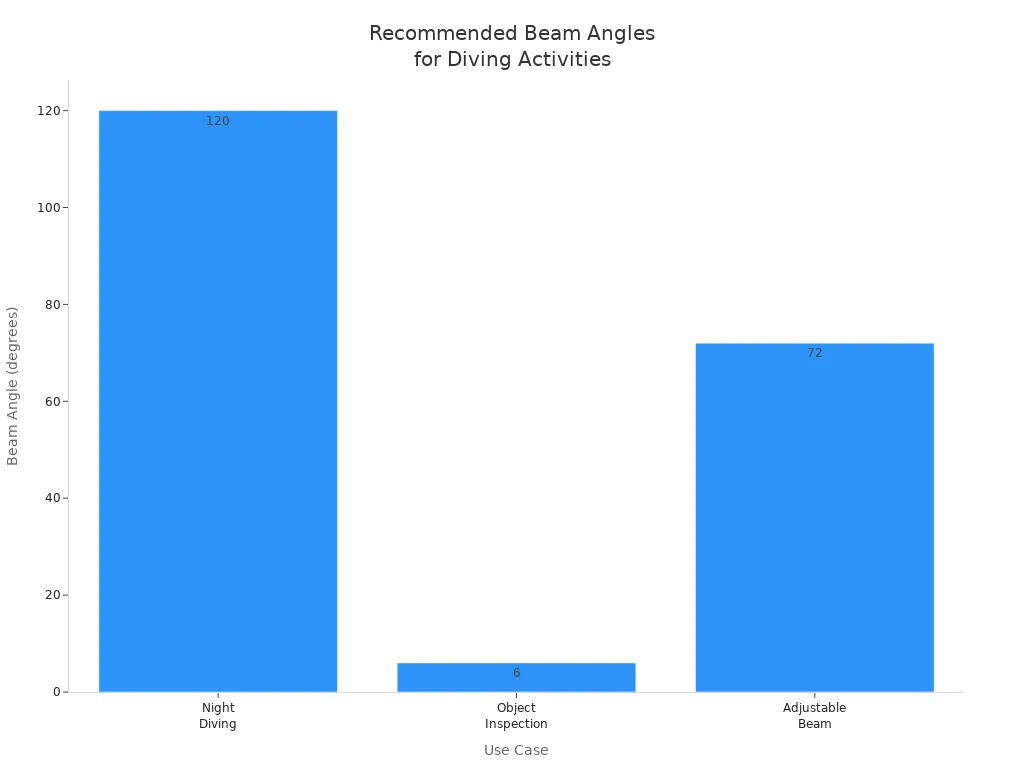
For night diving, a 120° beam angle gives you excellent coverage. For object inspection, a 6° beam provides a tight, focused spot. Adjustable beam lights can range from 4° to 72°, letting you adapt to your needs.
Brightness and Lumens
You need to pay close attention to the lumens rating when choosing a dive light. Lumens measure the total amount of visible light a device emits. The optimal lumens range depends on your activity and the environment.
Application | Optimal Lumens Range |
|---|---|
Spearfishing | 1000 to 1500 lumens |
Photography | 1000 to 1500 lumens |
Night Diving | 1000 to 1500 lumens |
For underwater photography, you may want a light with 2000 lumens or more, especially if your camera has low sensitivity. For most recreational dives, 1000 to 1500 lumens provide enough brightness output for clear visibility. Always remember that higher lumens can drain your battery faster, so balance your needs.
Battery and Burn Time
Battery capacity and burn time are critical for safety and performance. You should check the battery rating, usually measured in milliamp-hours (mAh). A higher mAh means longer burn time. Voltage and power also affect how long your dive light will last.
Here are some key points to consider:
Battery capacity (mAh) shows how much current the battery can deliver over time.
Voltage (V) affects the intensity of the light.
Power (W) tells you how much energy the light uses.
You can calculate current demand with: Current (A) = Power (W) / Voltage (V).
You can estimate burn time with: Burn Time (Hours) = Battery Capacity (mAh) / Current Demand (mA).
For long dives or technical diving, choose a light with a large battery and efficient power use. For short recreational dives, a smaller battery may be enough.
Color Rendering
Color rendering is especially important for underwater photography. Water filters out colors, so you need a dive light that restores true color to your images. Look for lights with a high Color Rendering Index (CRI). A higher CRI means the light shows colors more accurately.
Accurate color representation helps you capture the real beauty of marine life.
Custom white balance settings on your camera work best with high-CRI lights.
Video lights and proper color temperature improve your results.
If you want your photos and videos to look natural, always check the color rendering specs before you buy a dive light.
Tip: Always match your dive light features to your main activity and environment. This ensures you get the best performance, safety, and underwater experience.
Best Dive Light for Photography
High Lumen Output
You need a dive light with high lumen output to capture vivid underwater images. A minimum of 2000 lumens works best for most photography and video applications. High brightness ensures your subjects appear well-lit, even in low-light or deep environments. This level of illumination improves exposure, color accuracy, and contrast, which are essential for professional results.
Note: The quality of light can make the difference between a good and a great underwater photograph.
Characteristic | Impact on Underwater Photography |
|---|---|
Brightness | Essential for well-exposed images in low-light conditions |
Color | Affects the vibrancy and accuracy of underwater scenes |
Contrast | Enhances the depth and detail in images |
Adjustable Beam
You should look for a dive light with an adjustable beam. This feature allows you to switch between wide and narrow angles, making it easy to adapt to different shooting scenarios. For wide-angle photography, a beam angle of 90 to 100 degrees covers large scenes and group shots. For macro work, a narrower beam focuses the light on small subjects without creating harsh shadows.
Beam Angle | Application | Description |
|---|---|---|
90-100° | Wide-angle photography | Captures expansive scenes and large subjects |
≤90° | Macro photography | Focuses on smaller subjects with precision |
Color Accuracy
Color accuracy is critical for underwater photography. Water absorbs red, orange, and yellow light quickly, so you need a high-quality dive light with a neutral white color temperature around 5000K. This restores natural tones and makes marine life look vibrant in your photos and video. Underwater video lights with high color rendering index (CRI) help you achieve true-to-life results.
Red is the first color to disappear at depth.
Orange and yellow fade as you go deeper.
Blue and green penetrate the furthest, giving underwater scenes their signature look.
You can mount your dive light on your camera rig or use hands-free options for flexibility. Many underwater lights offer advanced features like red mode or auto flash-off, which are useful for both photography and video.
Dive Light for Spearfishing
Depth Rating
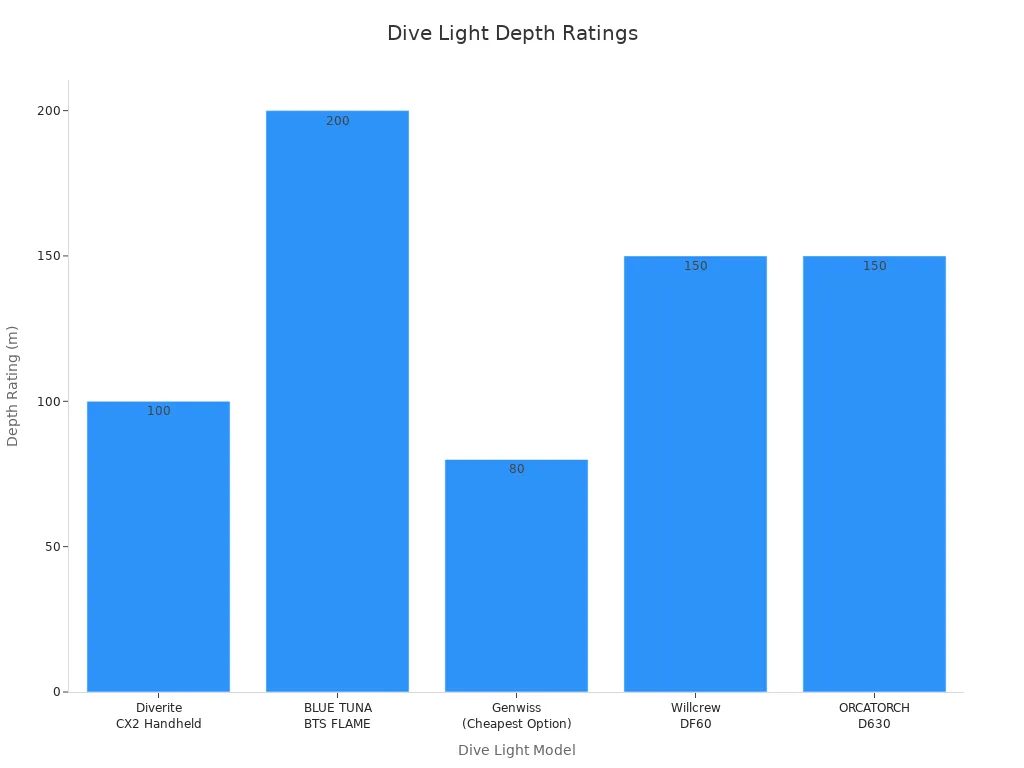
You must select a dive light with a depth rating that matches your planned dive. Spearfishing often takes you deeper than recreational diving, so you need a light that performs reliably under pressure. Manufacturers test dive lights for specific depths, and exceeding these limits can cause water intrusion or failure. The following table compares popular models and their depth ratings:
Dive Light | Depth Rating |
|---|---|
Diverite CX2 Handheld | Up to 100 m |
BLUE TUNA BTS FLAME | Up to 200 m |
Genwiss (Cheapest Option) | Up to 80 m |
Willcrew DF60 | Up to 150 m |
ORCATORCH D630 | Up to 150 m |
Tip: Always check the depth rating before your dive to avoid equipment failure.
Focused Beam
A focused beam helps you spot fish and navigate through murky water. You need a light that delivers a tight, concentrated beam to reduce backscatter and improve target visibility. Spearfishing requires precision, so a narrow beam lets you track movement without lighting up the entire area. Quick operation is essential; choose a dive light with simple controls for instant activation.
Focused beams increase accuracy when aiming.
Narrow beams minimize disturbance to marine life.
Simple switches allow fast response during the dive.
Durability
Spearfishing environments demand rugged construction. You need a light built from tough materials like anodized aluminum or reinforced polymer. Waterproof seals and impact resistance protect your gear from drops and rough handling. Many dive lights feature stealth modes, which reduce brightness to avoid startling fish.
Note: Reliable durability ensures your dive light withstands repeated use in challenging conditions.
A durable dive light gives you confidence during every dive, letting you focus on your performance and safety.
Dive Light for Night Diving
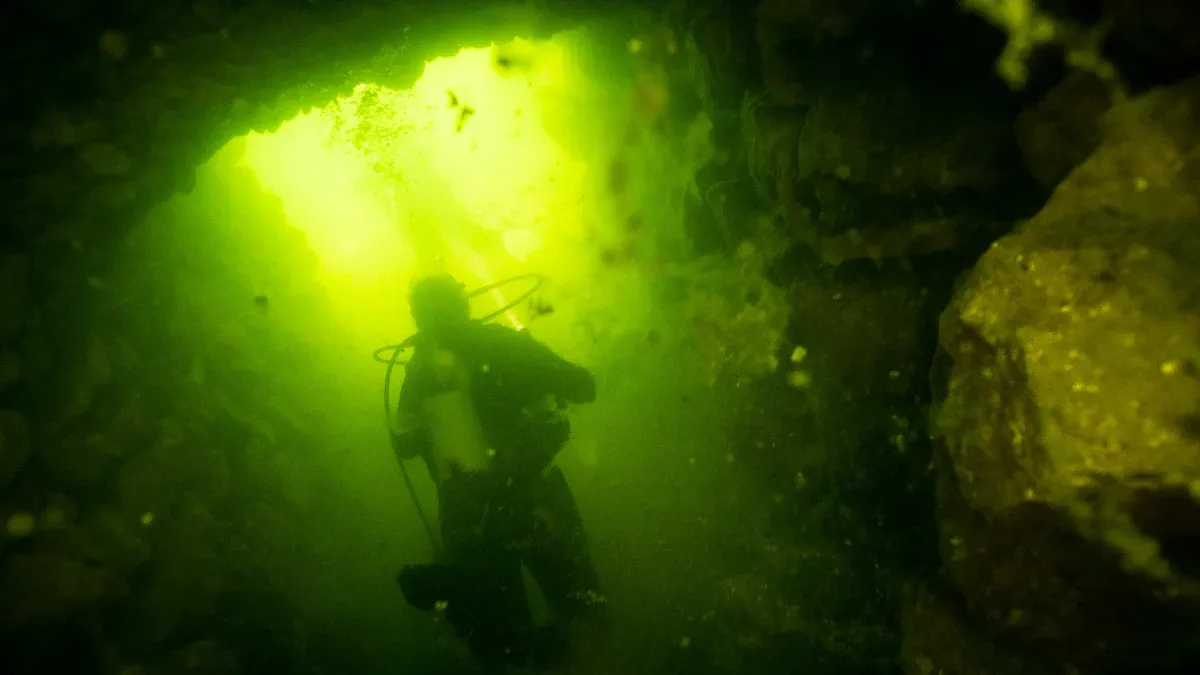
Wide Beam Floodlight
You need a wide beam floodlight for night diving to achieve broad, even illumination. This type of light lets you see your surroundings clearly and reduces harsh shadows. A wide beam covers a larger area, which helps you guide other divers and signal directions during night dives. You will find that a floodlight enhances your underwater experience by making navigation and communication easier. For basic illumination, 50-200 lumens may suffice, but higher brightness levels—between 1000 and 2000 lumens—offer better visibility, especially in deeper or darker water.
Tip: LED lights are the preferred choice for night diving because they provide efficient, long-lasting illumination.
Long Burn Time
You should always choose a dive light with a burn time longer than your planned night dive. Reliable illumination throughout your dive is crucial for safety. Many popular models offer burn times of about one hour at full power, which matches most recreational night diving needs.
Dive Light Model | Burn Time at Full Power |
|---|---|
Light with 100 m rating | Approximately 50 minutes |
Hydra 8000 V2 | 55–60 minutes |
Sea Dragon 5000+ | 60 minutes |
A long-lasting light ensures you never lose brightness when you need it most.
Backup Lights
You must always carry at least one backup light during night diving. If your primary light fails, a backup prevents you from being left in complete darkness. Choose a compact backup with enough brightness to help you return safely to your exit point. Many divers also use chemlights for extra safety, as they provide constant illumination without relying on batteries.
Carry a minimum of two lights for every night dive.
Select a backup with a wide beam for better illumination.
Chemlights add an extra layer of safety.
Note: Proper lighting and redundancy are essential for safe and enjoyable night diving.
Helius Flashlight and Technical Dive Lights
The helius flashlight stands out as a top choice for technical divers who demand reliability and performance. You will find that this light offers features designed for the most challenging underwater environments. When you prepare for technical diving, you need equipment that can handle deep depths and long durations. The helius flashlight meets these needs with advanced engineering and robust construction.
Canister Light Advantages
You should consider a canister light like the helius flashlight for your technical dives. These lights offer several key benefits:
You get longer burn times, which are essential for extended or complex dives.
The helius flashlight provides high lumen output, often exceeding 1000 lumens, so you enjoy excellent visibility in dark or murky water.
Canister lights deliver a well-defined beam pattern, combining both spot and flood elements. This versatility helps you adapt to different underwater conditions.
You benefit from reliable performance, even in challenging environments. The helius flashlight maintains consistent brightness and resists water intrusion.
The long burn time of the helius flashlight often exceeds your planned dive duration, giving you peace of mind during technical diving.
Tip: Choose a canister light if you want a dependable solution for technical or deep dives.
Extended Burn Time
When you use the helius flashlight for technical diving, you gain a significant advantage with its extended burn time. This feature allows you to explore caves or wrecks without worrying about losing your primary source of light. You can focus on navigation and safety, knowing your helius flashlight will last throughout your dive. Extended burn time is not just a convenience—it is a critical safety factor for every technical diver.
Buying and Maintaining Your Dive Light
Budget and Value
You want to get the most out of your dive light investment. Start by comparing materials. Aluminum offers strength, titanium gives you extra durability, and polycarbonate keeps your light lightweight and impact-resistant. A comfortable grip and balanced weight make your light easier to use underwater. Always check that your dive light has proper sealing to prevent water damage. Look for models that balance cost and quality. Energy-efficient lights help you save money over time.
Choose materials that match your diving needs.
Pick ergonomic designs for better handling.
Make sure the light is well-sealed for reliable performance.
Consider long-term savings from efficient models.
Brand and Warranty
You should pay attention to brand reputation when selecting a dive light. Brands that focus on safety and durability often deliver better products. Many companies now support responsible sourcing and community initiatives, which builds trust and loyalty. Products that meet strict safety standards and ethical practices align with what divers expect. A solid warranty gives you peace of mind and protects your investment.
Brand Feature | Benefit to You |
|---|---|
Reliable performance | |
Responsible Sourcing | Social responsibility |
Warranty Coverage | Protection for your equipment |
Tip: Always check the warranty details before you buy a dive light.
Care and Storage
Proper care extends the life of your dive light. Rinse your light with fresh water after every dive to remove salt and debris. Dry it completely before storing. Store your light in a cool, dry place away from direct sunlight. Check the seals and battery regularly to prevent leaks and corrosion. Replace worn parts as needed to keep your equipment ready for every dive.
Rinse and dry your light after each use.
Store in a safe, dry location.
Inspect seals and batteries often.
Replace damaged parts quickly.
Note: Good maintenance ensures your dive light stays reliable for every underwater adventure.
You should focus on your main dive activity, match features to your needs, and always choose reliable gear.
Review your options before every dive.
Consult with professionals for advice.
Tip: Create a checklist to help you select the right dive light for every adventure.
FAQ
What is the best way to maintain my dive light?
Rinse your dive light with fresh water after every dive. Dry it completely. Store it in a cool, dry place. Check seals and batteries regularly.
How many lumens do I need for underwater photography?
You need at least 2000 lumens for clear, vibrant photos. Higher output improves color and detail, especially in deep or low-light conditions.
Can I use the same dive light for all activities?
Activity | Recommended Light Type |
|---|---|
Photography | High-CRI, wide beam |
Spearfishing | Focused, rugged |
Night Diving | Floodlight, long burn time |
You should match your dive light to your main activity for best results.
See Also
How Diving Flashlights Differ From Standard Flashlights
Top Recommended Scuba Diving Headlamps According to Reddit Users
Selecting The Perfect Rechargeable Flashlight For Hiking Adventures